
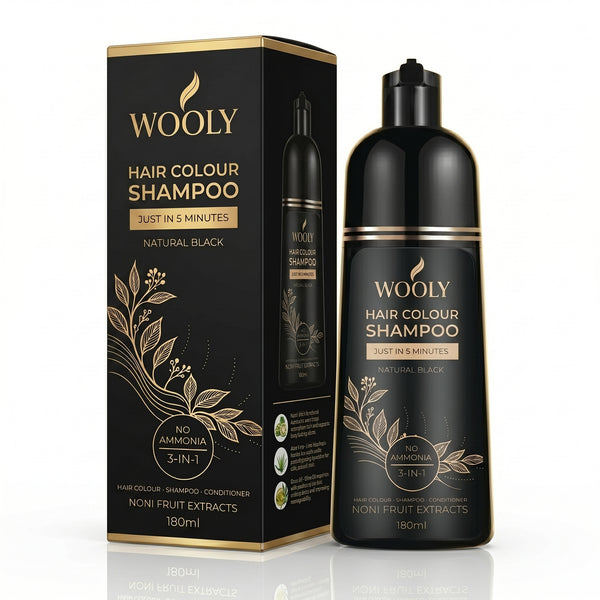
Wooly Hair Colour Shampoo
A shampoo, not a dye. No ammonia. No mixing bowl. No salon visit. Apply on damp hair, wait...
Rs. 899
Shop →One product. One promise. Grey gone.
A shampoo, not a dye. No ammonia. No mixing bowl. No salon visit. Apply on damp hair, wait...
Rs. 899
Shop →A hair colour shampoo is colour you use in the shower instead of a separate dyeing session. You lather it in, leave it the stated time, and rinse. Wooly Hair Colour Shampoo is ammonia-free, needs no mixing and no developer, processes in five minutes, and holds for about two to three weeks before you top it up.
Most people arrive at a colour shampoo after deciding a full dye session is more process than they want every few weeks. This page covers what the format does well, where it does not, and how to use it properly.
A traditional permanent dye opens the hair cuticle with an alkaline agent and a peroxide developer so pigment can be built inside the strand. That is why it lasts, and why it takes mixing bowls, gloves and half an hour.
A colour shampoo deposits colour closer to the surface during a normal wash. The practical differences:
If you are weighing the two formats properly, we compare them in detail in colour shampoo vs hair dye.
The formula is the same — there is no separate men's colour chemistry. What differs is where the grey shows and how much product it takes. Men covering grey are usually working on temples, sideburns and the hairline in shorter hair, which needs less product per wash and makes the five-minute routine easy to repeat.
Wooly Hair Colour Shampoo can also be used on beard and moustache. Temples are the common problem area and the hardest to cover well — there is a full walkthrough in covering grey for men and why temple grey is the hardest spot.
Same product, different working area. Grey usually shows first along the parting and the hairline, and longer hair simply needs more product to carry colour from root to mid-length. Budget more per wash than the temple-only routine above, and work the parting first while the lather is densest.
On shade choice and what a single-shade product can and cannot do for you, see choosing a shade.
A 180 ml bottle gives up to 20 washes.
Wooly Hair Colour Shampoo is ammonia-free, and that is a real formulation fact rather than a marketing line. It is also an oxidative colourant, and it contains PPD — the dye intermediate behind most hair-colour allergies. That is why the 48-hour patch test matters, and why the product is not suitable if you have sensitive or allergy-prone skin or a known hair-dye allergy. Speak to a doctor first if you have an existing scalp condition.
The full ingredient list is published on the product page. For what the ammonia-free claim does and does not cover, see our guide to ammonia-free hair colour.
There is no single answer, and any brand that tells you otherwise is selling rather than advising. Judge on four things: whether the coverage matches how much grey you have, how often you are realistically willing to repeat it, whether the shade range includes yours, and what the ingredient list says once you read past the front of the pack.
"Safe" depends on the formula, your skin and how often you use it, not on the product category. Most colour shampoos contain a dye intermediate such as PPD, which carries an allergy risk that a patch test exists to catch — including for long-time users, because sensitivity can develop over time. Our ingredient breakdown covers this properly.
Yes, within its limits. It genuinely covers and blends grey, and for scattered to moderate grey the result reads well. It will not match a permanent dye on dense, coarse or resistant grey, and it needs topping up every few weeks rather than growing out.
About two to three weeks before a top-up, fading gradually rather than leaving a root line. There is a fuller breakdown in how long it actually lasts.
No, and the two get confused constantly. A colour shampoo adds colour. A colour-safe or colour-protect shampoo adds none — it is a normal cleanser formulated to make existing dye fade more slowly. If your hair is already dyed and you only want the colour to last, you want the second kind, not this one.